For over a decade, NVIDIA's TITAN line has represented the absolute pinnacle of consumer graphics technology — cards that blurred the boundary between workstation hardware and gaming powerhouses. From the original Kepler-era flagship to the ray-tracing revolution of the Turing architecture, the TITAN family tells the story of how GPUs evolved from rendering games to reshaping artificial intelligence, scientific computing, and professional content creation.
GTX TITAN
When the original
GTX TITAN arrived in February 2013, it was unlike anything the consumer market had seen. The GK110 chip powering it was the very same silicon used in the Tesla K20X — a compute card found inside the Titan supercomputer at Oak Ridge National Laboratory, one of the most powerful machines in the world at the time. NVIDIA stripped away little, giving the card 2,688 CUDA cores and a massive 6 GB GDDR5 framebuffer on a 384-bit memory bus. The result was a card that could hold its own in professional workloads while still being something you could put in a gaming rig. At $999, it wasn't cheap, but it set the template for everything that followed.
GTX TITAN Black
Exactly one year later, the
GTX TITAN Black refined the formula. NVIDIA swapped in the revised GK110B die and pushed memory bandwidth from 288.4 GB/s up to a considerably more muscular 336.0 GB/s, thanks to a bump to 7.0 Gbps GDDR5. The TITAN Black also unlocked double-precision compute performance, making it even more attractive to researchers and engineers who wanted a single card that could serve double duty. The price stayed at $999 — the same as its predecessor — making it one of the more straightforward value propositions in the TITAN lineup.
GTX TITAN Z
If the TITAN Black was a refinement, the
GTX TITAN Z was an ambition. Launching in May 2014, it was NVIDIA's boldest dual-GPU card to date — two complete GK110B chips on a single PCB, with 12 GB of GDDR5 memory split evenly across both GPUs. On paper, it was monstrous. In practice, it arrived at $2,999 into a market where AMD's Radeon R9 295X2 was offering comparable dual-GPU performance at a lower price point. The TITAN Z remains one of the most extraordinary-looking pieces of hardware from the Kepler era, and a fascinating footnote in NVIDIA's history of pushing consumer hardware to its logical extreme.
TITAN X
With Maxwell 2.0, NVIDIA took a different approach: instead of brute-force transistor counts, the architecture focused on efficiency. The result was remarkable. The
TITAN X, announced personally by Jensen Huang at GDC 2015, packed 3,072 CUDA cores and 12 GB of GDDR5 across its 384-bit bus. This was the first TITAN to double the framebuffer of its predecessor, and the 12 GB figure would become a defining spec of the line going forward. Back at $999, it was also the most accessible high-end TITAN in years.
TITAN X Pascal
Pascal represented a generational leap, and the
TITAN X Pascal was its crown jewel when it launched in August 2016. Built on TSMC's 16nm FinFET process — a significant shrink from Maxwell's 28nm node — the GP102 chip brought 3,584 CUDA cores and, critically, GDDR5X memory running at 10.0 Gbps. That pushed bandwidth to 480.4 GB/s, a massive 43% jump over the Maxwell TITAN X. The price crept up to $1,199, but performance gains more than justified the premium. It also marked the moment NVIDIA began quietly distancing the TITAN brand from the standard GeForce lineup in terms of branding identity.
TITAN Xp
Just eight months after the Pascal TITAN X, NVIDIA raised the bar again with the
TITAN Xp. The same GP102 chip, but this time fully unlocked — all 3,840 CUDA cores enabled — and GDDR5X clocked to 11.4 Gbps, squeezing 547.6 GB/s of bandwidth out of the 384-bit bus. It was the fastest single-GPU card money could buy in early 2017, and at $1,199 it matched its predecessor's price exactly. Then NVIDIA did something unexpected.
Limited Editions
In late 2017, NVIDIA released two limited-edition TITAN Xp Collector's Edition cards in collaboration with Lucasfilm and Star Wars — one adorned in the crimson and steel aesthetic of the
Galactic Empire, and one celebrating the
Jedi Order. Beyond the striking shrouds, both cards were fully functional TITAN Xps under the hood. They remain some of the most visually distinctive pieces of PC hardware ever produced, commanding significant premiums on the secondhand market to this day.
TITAN V
The
TITAN V was a radical departure. Unveiled without warning on December 6, 2017, it was the first consumer product to feature Volta architecture and the GV100 chip — the same silicon at the heart of NVIDIA's V100 data center accelerators. HBM2 memory replaced GDDR5X entirely, running on an extraordinary 3,072-bit bus and delivering 651.3 GB/s of bandwidth. It introduced Tensor Cores to the consumer space for the first time, enabling mixed-precision deep learning at speeds previously reserved for server rooms. At $2,999 it was unapologetically a card for researchers, academics, and developers — but the fact that it existed as a consumer product at all was remarkable.
The CEO Edition
In June 2018, NVIDIA went further still. The
TITAN V CEO Edition — a name that leaves little ambiguity about its target audience — quadrupled the memory to 32 GB of HBM2 on a 4,096-bit bus, pushing bandwidth to an astonishing 868.4 GB/s. It was never meant for gaming; it was a machine learning and scientific computing instrument that happened to fit in a PCIe slot. The name itself became a piece of tech culture lore.
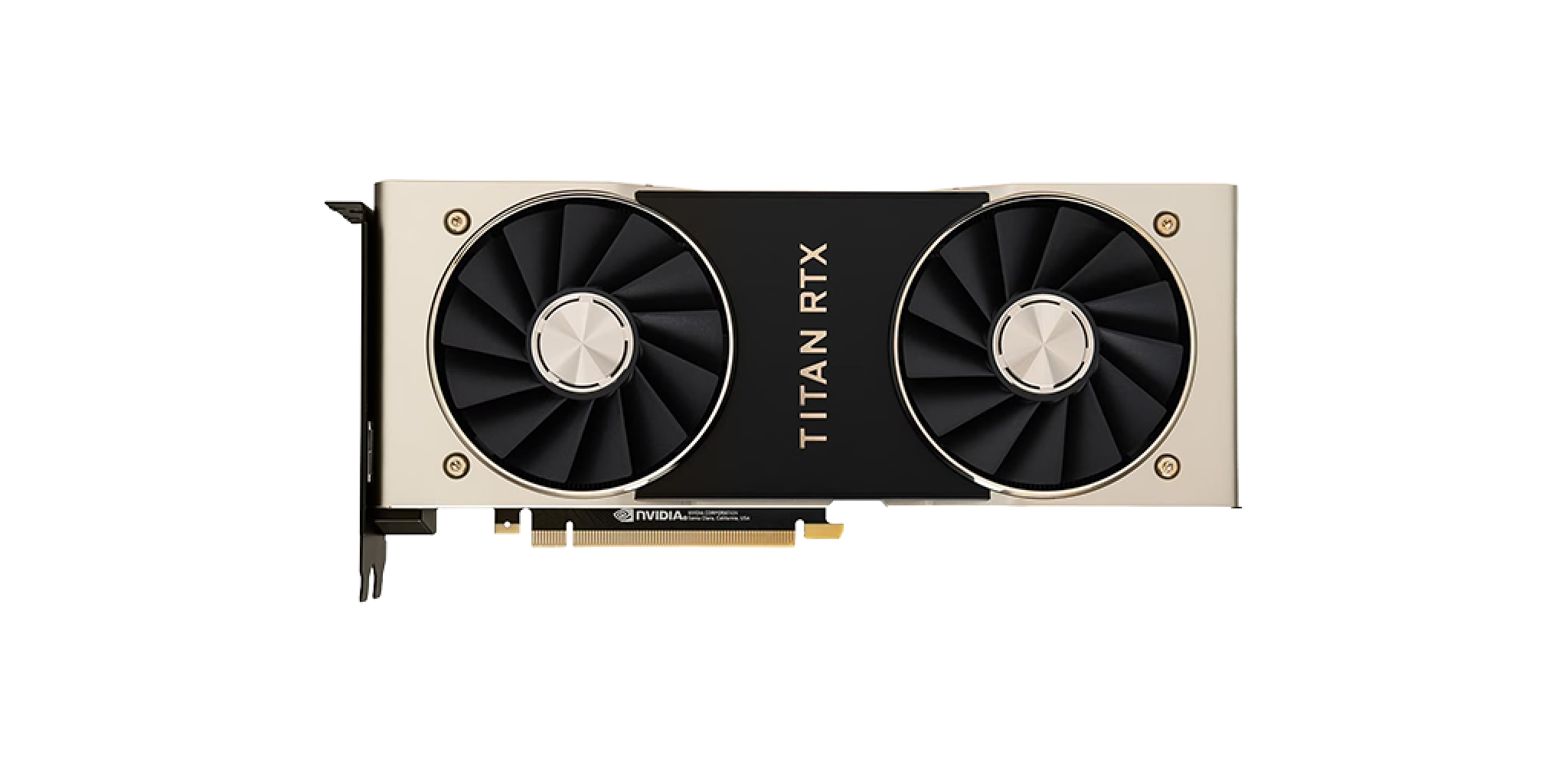
TITAN RTX
The final chapter of the TITAN story — at least in this form — arrived with the
TITAN RTX in December 2018. Turing brought real-time ray tracing and AI-accelerated rendering to the table, and the TITAN RTX packed the full TU102 die with 4,608 CUDA cores, 576 Tensor Cores, and 72 RT Cores. The 24 GB of GDDR6 memory, running at 14.0 Gbps on a 384-bit bus, was the most VRAM ever shipped on a standard consumer card at the time — a spec that made it genuinely compelling for 3D artists, machine learning practitioners, and video editors working with large datasets. At $2,499, it was expensive but not stratospheric by TITAN standards. Jensen Huang called it "the world's most powerful PC GPU" — a claim that was, at the time, simply accurate.
Find the full list in our
GPU Database to find all the information about the TITAN GPUs!
The creator and owner of Hashrate.no goes by the alias r0ver2. With years of hands-on experience working with GPU hardware, he started building and configuring his own systems in 2017 — gradually scaling from a home setup to a larger multi-GPU operation, gaining deep technical knowledge of hardware management, power delivery, thermals, and system stability along the way.
Last updated: March 23, 2026












 MEXC Exchange
 MinerBros
 Jingle mining
 Kryptex
 gpus.net
 gpus.no
 gpus.se
 gpus.dk